
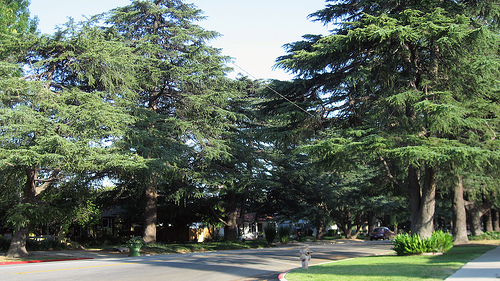
The Deodar cedars line the sleepy street of White Oak to the north of where I live. The trees tower many feet over the well-manicured homes, set back far from the street. The wide avenue, built to handle plenty of cars, sees but only a few with one single stop sign at the end of the block. A couple walks their small, white toy poodle down a quiet residential sidewalk covered in a blanket of pine needles.
Five miles south on the same block renowned for its cedar trees (yet are predominately lacking), I look out my window and see a beater van parked indefinitely outside of my home. A group of five men from the nearby wayside house, quietly disguised behind a large, black fence, saunter down the sidewalk. The alley where I enter and exit from my garage is riddled with graffiti of the unattractive kind.
Though only five miles apart, the scenes from my current neighborhood and the one I grew up in are worlds apart. The “Valley”, once known as a rustic get-away for the celebrities of yester-year, has grown into a hodge-podge of seedy neighborhoods intermixed with a “good” pocket every now and again. The valley is perplexing; a large, flat sprawling suburb built on a seemingly-endless grid system bordered with rolling hills and mountains. Without the obvious barriers, the cities merge into one another with barely a marker to distinguish you’ve entered into a new zip code.
But why is one town so well taken care of, while another just a few miles away without any geographic barriers, has become a dumping ground for litter, graffiti and over-grown lawns?
Due to the lack of physical barriers, cities seem to define themselves through subtle cosemetic differences: graffiti and litter,or statues, pergolas, and renovated shopping centers built to attract consumers willing to spend. Since I’m not a city counsel member, I can only assume a city’s budget and income are dependent on property tax, and the concept that the community will continue to generate income within its own city.
A few things I’ve noticed that may be directly related to the differences between these two towns (I’ll call them town A and town B) are:
Town A:
- A small, well-maintained business center reminiscent of the 1950’s. Though many stores have closed due to the recession, the landlords haven’t allowed strip clubs or Triple-X stores to open in their place. The town recently built a statue and seating area at the beginning of the 4-block district under a giant Deodar Oak to show their dedication to their small, yet clean business area. One can tell the residents pride themselves on these four blocks – very rarely do you see graffiti.
- Well maintained lawns. During the real estate boom, this area increased in price by a near 4-fold. Even though this area has been hit hard by the drop in prices, there aren’t very many homes for sale or overgrown lawns. Either people have lived in these homes a long time, or the people able to afford these homes are doing okay financially. I assume this area is financially stable.
- Renovated shopping center. Over the past few years, the city took a very old, vacant shopping center and completely renovated it making it the center shopping district complete with grocery store, home store, and plenty of fast-food restaurants. (The high school kids love it.)
- A renowned high school. It’s funny, I graduated from this very same high school many, many years ago. However, it has since turned into a well-respected charter school that is the envy of all who can’t get their kids into it.
- Movies filmed: E.T. was filmed all over Town A from the trees you see in the photo above to the homes being built in the surrounding hills in the late 1970’s early 1980’s. Fast Times at Ridgemont High car scenes were filmed in Town A’s business district.
Town B:
- A run-down business district. Back in the 1950’s, the area near my house was one of the first bustling business districts of the valley. Unfortunately, time has not been very good to this center. Riddled with graffiti, burned out buildings, and corner payday loan offices, the business district lacks a cohesive purpose.
- Over-grown lawns and vacant homes. During the bubble, prices in my area peaked over $500,000. I feel terrible for the people who purchased homes at these prices considering the area really isn’t deserving of those prices. I’m beginning to think they feel bad for themselves as well, as many have walked away from their homes.
- Corner Mini-Marts. Sprinkled at almost every busy intersection is a mini-mart. Great for a quick soda. Not so good for a community. How many liquor stores does one city need?
- Low-income apartment buildings for blocks on end. People from every economic level need a place to live. Unfortunately landlords often associate low income with low maintenance; uncared for properties quickly become the target for graffiti, broken windows, and littered lawns only further depressing an already depressed area.
- Movies Filmed: Boogie Nights was filmed on a busy street in Town B. The television show My Name is Earl was filmed extensively around my neighborhood as well. (Note the glaring difference?!)
What are the solutions for town B? Obviously, the economy picking up steam would help; fewer people leaving the area would fill the vacant homes. Home owners tending to their lawns and cleaning up the graffiti would also be a positive movement. I’ve found that if graffiti is painted over immediately in an area, the tagger usually moves on to another area that doesn’t seem to care as much.
Perhaps I need to make it a point of walking up and down my alley painting over graffiti-covered walls. Maybe I need to begin picking up litter within a 1-mile block range; my initiative alone could cause a much larger change by encouraging my neighbors to do the same. This may be my Labor Day Weekend goal.
What changes have you seen in your town? What is the solution? Is there anything you could do to help?


8 Comments
In econ that’s called the “broken windows” hypothesis. There’s mixed evidence on whether or not the painting over graffiti etc. works. Sometimes it does, sometimes it doesn’t. It is definitely worth a try, and once it is the norm, other folks may follow. Networks are really strong.
Sometimes gentrification makes things worse for people living in the poor city because they can no longer afford to live there and end up someplace even more dangerous.
.-= Nicole´s last blog ..Cooking for 1 =-.
@Nicole – I think I’m going to try cleaning up my alley a bit. I think my neighborhood is sort of on the brink: it could either really improve over the next few years or go down the tubes. And you’re right, gentrification does make it worse for the very poor; as the neighborhood becomes nicer, real estate prices creep up pushing the low income renters out of the area. However, I don’t think caring for one’s neighborhood is necessarily a bad thing, keeping the graffiti to a minimum and cleaning up the trash is a good habit. Now if only the strip clubs would stay away!
Hmmm, sounds like a great idea! Are there other like minded people in your neighborhood that could help? Perhaps if your community as a whole (or partial whole) gets involved, maybe people would be more aware of the problem?
My old hometown is completely rundown, but it’s more an aspect of the people living there, and not the economic downturn.
As far as your idea to clean up the neighborhood, I think it’s great. You can use this blog to draw attention to your efforts and get others involved!
@Khaleef – Thanks for the words of encouragement. I’m thinking that a few people in the neighborhood would chip in; I’ve not completely lost hope with my neighbors!
@Jennifer Barry – Those are good questions. I wonder if a lot of good “pockets” also are determined through city planning. For instance, the better neighborhoods in my city are north of the railroad tracks. Because the tracks run east and west, some of the less-trafficked streets don’t run all the way through; in essence, it cuts off one neighborhood from another.
It’s interesting how in Dallas, small areas have become their own mini-cities with their own police force and school district. Very interesting!
Interesting post. I have always been fascinated on how places can evolve and devolve. Where I’m at, things have pretty much stayed the same on the surface. Business seems to be doing well, and newer businesses have opened. Behind the scenes, however, home prices have dropped a bit – to the tune of 25% in the last few years, from what I’ve seen. Suburban Chicago seems to be impacted that way, without much other big noticeable differences.
If you want to see a place with a stark contrast between two communities, you should check out the Northeast border of Detroit, and it’s border with Grosse Point communities. It goes from a large stretch of upper-middle class suburban communities to a very tough area just by crossing the street into Detroit. While I live in Chicago, I have spent time in Detroit and recall how remarkable that crossover was.
.-= Squirrelers´s last blog ..Young Children Can Have Lots of Fun with Inexpensive Activities =-.
@Squirrelers – Detroit is an interesting anomaly indeed. I’ve seen homes on eBay for $5,000 in really run-down areas and whole blocks for sale. It’s quite strange how the two communities border each other and are so opposite. I wonder if there’s a physical barrier, somehow related to poor city planning, that has created the difference. It would make for an interesting study.