
I’ve always had a curiosity about how a once rural section of town transformed into a suburban area. What was the initial motivation to create suburbs? How did city planners affect the overall layout? Why did they choose a grid layout?
I live in the San Fernando Valley. Once a place of idyllic ranches owned by Hollywood’s elite actors and actresses of the 1930’s and 1940’s. It was a place where the famous could wind down and get away. Howard Hughes filmed the 1920’s film Hell’s Angels out of the Van Nuys airport (then called the Metropolitan Airport). Lucille Ball and Ricky Ricardo owned a ranch along side Barbara Stanwick and the Marx Brothers. Clark Gable and Carole Lombard’s Encino ranch wasn’t far from the original Tarzana ranch (owned by the creator of Tarzan), which is now the city of Tarzana. Brochures touted the beautiful Twin Lakes community, a community which no longer has a lake, in northern Chatsworth, off the 118 freeway. Calabasas, in the 1930’s, was being sold originally as an artists colony. Now it is filled with multimillion dollar homes owned by very wealthy business owners, few artists can afford to reside in such a place.
How did it become the suburban metropolis that it is now? What happened to those original homes and ranches? Why didn’t it retain some of it’s communities original plans? There, of course, is a very long history to the San Fernando Valley area beginning with the native Tongva peoples, and the building of the San Fernando Mission during the Spanish mission period. Yet, the beginning of the suburbs start around the early 1900’s.
Prior to 1913 and the building of the Los Angeles aqueduct, the valley was very dry, a semi-arid topography that couldn’t support a huge population. After this aqueduct was completed, there was a huge boom in housing developments. Automobiles and the development of freeways helped connect this valley area to the greater Los Angeles area, an already booming city.
I found a terrific link, an article written by Charlotte Laws, Ph.D., that clearly states the problem with suburbia, or at least the Valley. Here is an excerpt from her article:
“As Los Angeles’ pastoral backyard, the Valley seemed an ideal place to realize these new notions of metropolitan community. Yet ultimately Los Angeles failed to capitalize on them. Some Progressive ideas were incorporated into the development of the older sections of the City—as the parks west of downtown will bear witness—but by the 1920s, these increasingly began to fall by the wayside. The costs of the aqueduct, and other infrastructure, were part of the problem; so too was the desire of developers, in the Valley as elsewhere, to maximize the profits on their land.
As a result, Los Angeles grew, and the Valley most notably, with a shocking lack of parks, green space or attractive public areas. The developers ignored the advice of city officials to designate parklands for their subdivisions, and by 1928, parks took up a mere 0.6% of the City. Later attempts to re-fashion the City—notably the 1930 Olmstead Plan—that would have placed park, river, and open space development at the center of the city plan, never materialized.”
This, of course, explains part of our suburban problem here in the SF Valley. My guess is that it’s not only here that we experience these problems, but in many suburban areas. Suburban areas seem like an after-thought. A city doesn’t project their population growth accurately, then struggles to catch up with it, only to realize that their plans forgot something. That something they forgot to do is create parks and roads that are pedestrian friendly, land-locking the suburbs within their concrete grid-system.
So what happened to those ranches owned by the late actors of the 1930’s and 40’s? Some of them got razed when developers purchased their land only to build a few hundred homes. Others got re-purposed, for example, there is still an old home sitting at the western corner of a small intersection, that has been turned into a special education school. Supposedly, it was the home of Will Rogers.
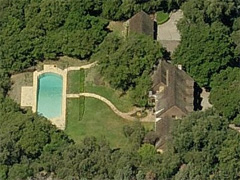
There is one home left, that of Barbara Stanwick (then owned by Jack Oakie), that still sits on its original, untouched, 11-acres. It was sold this past year, but I’m not sure to whom. About a year ago, it had been sold to a developer, but that developer had run out of money to build. My husband and I went to the property and jumped the fence (yes, we were trespassing!). I’m curious, what can I say?! We peeked in the windows of the home, it had looked like it had been redecorated in the 1970’s with blue carpeting. The dark wooden floors were still intact and in good repair. The small 3-car garages and flagstone bricks were all in good shape. The pool was also taken care of, nice and clean, with a large chain-link fence surrounding it (to keep people out). The tennis courts below the house looked a little worn. The rolling 11-acres were overgrown and brown at the time of our visit, due to lack of rain.
Luckily, I did some research and found that the home is land marked, meaning it can’t be torn down. Only time will tell what will happen to that remaining 11-acres sitting between a Honda Dealership and the aqueduct.


4 Comments
That’s neat you got a peek inside Barbara Stanwyck’s old home. But honestly, 11 acres stuck between an aqueduct and a car dealer? It’s hard to imagine anyone wanting that property now.
It’s now in a strange location, but the surrounding houses and neighborhood are considered a great area still. The house is also surrounded by so much land, that I think you could almost forget about the dealership!
The small city nearest to us is experiencing growth issues in that they didn’t plan very well for the explosion that occurred a few years ago. I have always thought Phoenix was very well laid out – on a grid – makes it infinitely easier to navigate than when streets are wind around and don’t make any sense.
Thanks for your comment. Many of my husband’s family lives in the Phoenix/Mesa area. This area has definitely grown a lot over the years. Each time we visit, there is a new community cropping up in the outlying areas. A grid-system does make finding streets easy, I agree. I just wonder if there is a better way to unite the communities with shops. For instance, many newer communities are enclosed in a wall type surrounding. Shops and restaurants are outside of this area, making it difficult to walk or bike to easily. Just a thought!